• MY FINANCIAL WELLBEING
  • EVENTS
    • BLOG
    • LIBRARY
    • THEMES
    • IF BLOG
    • IF LIBRARY
    • ABOUT
    • CONTACT
Menu

Own the way you live

Where finance, leadership and technology shape better decisions
  • MY FINANCIAL WELLBEING
  • EVENTS
  • BLOG
    • BLOG
    • LIBRARY
    • THEMES
  • ITALIAN FLAIR
    • IF BLOG
    • IF LIBRARY
  • ABOUT
    • ABOUT
    • CONTACT
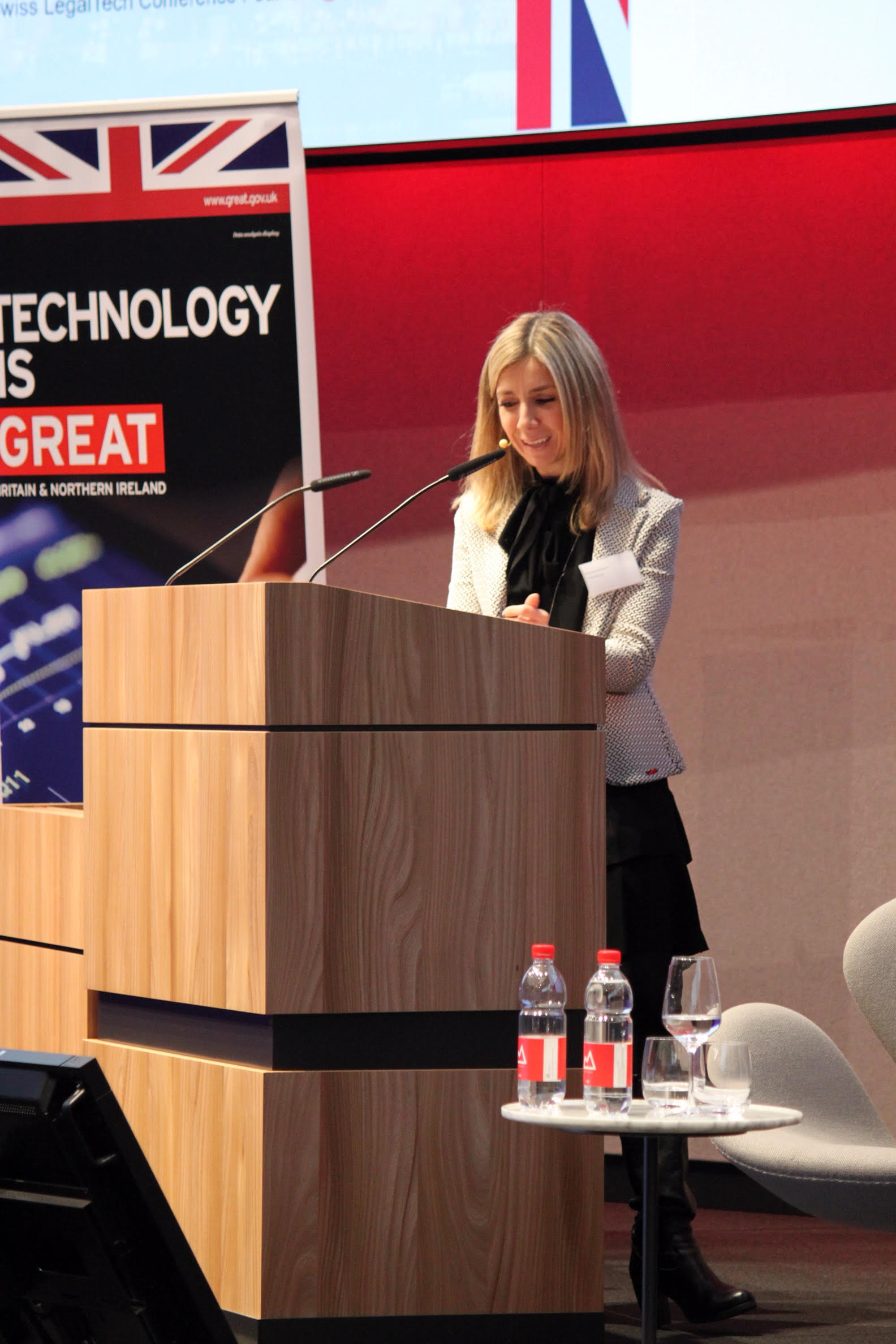
Manuela Andaloro discussing the topic of diversity and EQ-driven leadership at a recent FinTech event in London (Payexpo 2019).

Manuela Andaloro discussing the topic of diversity and EQ-driven leadership at a recent FinTech event in London (Payexpo 2019).

Bringing EQ-driven leadership into companies.

July 30, 2019

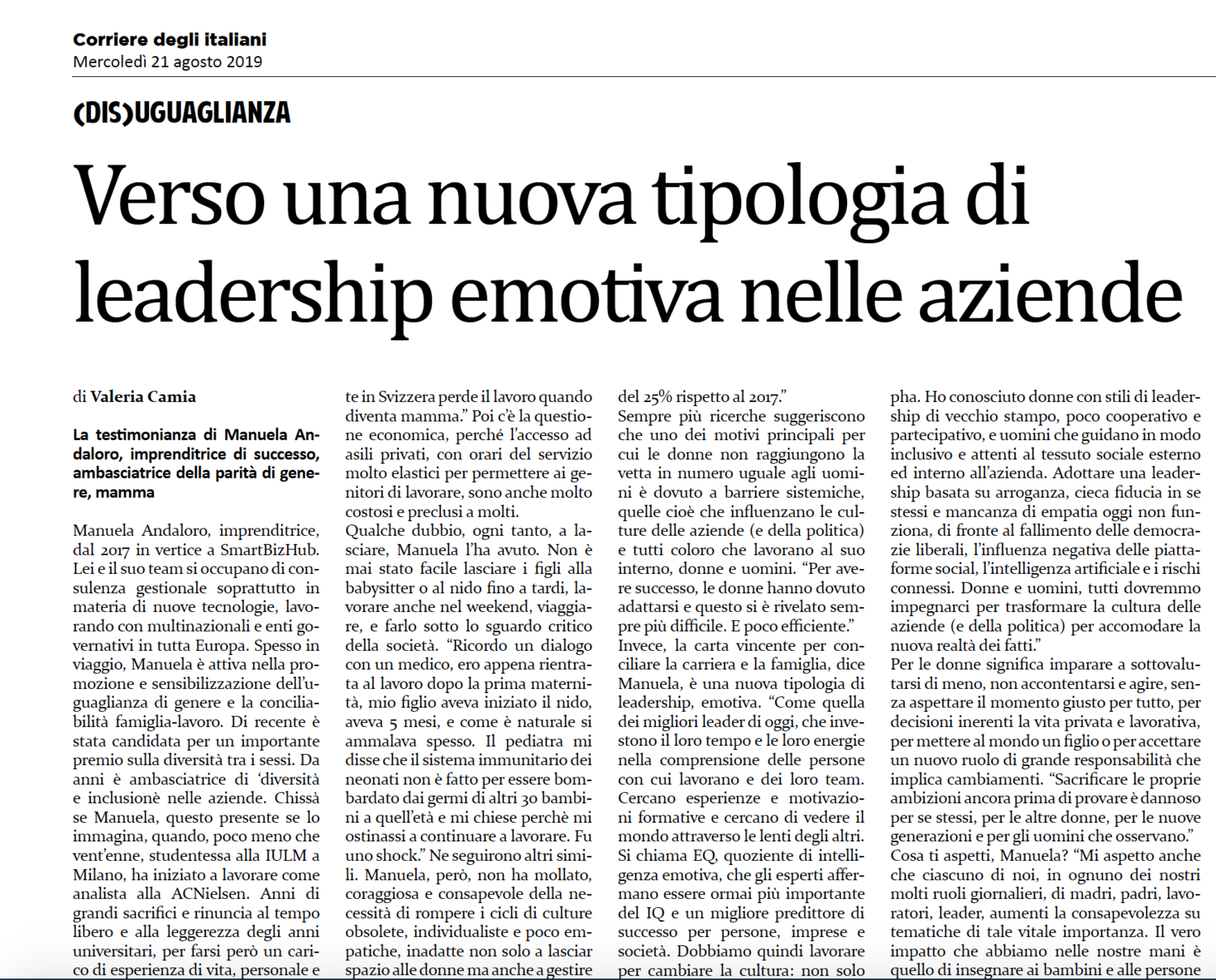
Interview by Valeria Camia, journalist, web director Corriere dell'Italianità, to Manuela Andaloro Senior Advisor and Board Member, for Corriere degli Italiani

A successful entrepreneur, an ambassador of gender equality, and a mother, Manuela Andaloro tells her story. 

Business woman Manuela Andaloro has been the CEO of SmartBizHub since 2017. Together with her team, she does management consulting, especially in the field of new technologies and sustainability, working with multinationals and government agencies throughout Europe. Manuela travels often and is active in advocating and raising awareness on diversity, gender equality and on the balance between family and work. She was recently nominated for a major award on gender diversity. For many years, she has been advocating “diversity and inclusion” in companies. Could Manuela picture her current reality when, just a twenty-year-old student at IULM University in Milan, she got her first corporate role as an analyst at ACNielsen, working hard to keep up with her studies?

Manuela has been not only a successful entrepreneur in recent years, for over 17 years she has had important roles in leading financial companies in Europe, since 2012, she’s also a mother. A mother of two small children (4 and 6 years old), in Switzerland, a country in which achieving a balance between family and work is particularly complicated. Maternity leave is granted for only 3 months and fathers are excluded, as opposed to a European average of 6 to 12 months (or even 3 years in Germany) of leave, which in many cases can be shared equally between both parents. If wage parity remains a dream, the same goes for career opportunities, respect for diversity and promotion of social inclusion.

“Finding a balance between career and family is one of the hardest challenges that my husband and I – along with hundreds of parents with careers, I have met over the years – are facing in Swiss society, which in most cases still gives women the role of housekeepers and child carers. This concept is deeply rooted in the culture of this country. I still remember this chat I had with a doctor I had consulted because I felt tired after the birth of my first child and my return to work 5 months later. I remember the doctor asking me why I kept on working. It was shocking. And that was just the beginning. I was shocked again when I went back to work, first part time, then full time. Society in many cases expected me to be mainly a mother”, says Manuela, who considers herself lucky, because “there was still a job for me when my maternity leave was over if you consider that one in seven women in Switzerland loses her job when she becomes a mother.” Not to mention the economic situation, as private nurseries and kindergartens, that can provide more flexible times to allow parents to work, are very expensive and so precluded to many.

To be honest, Manuela actually had some thoughts about giving up her career, or taking a break. It was never easy to leave my children with the babysitter or at the nursery until late, to work and travel even on weekends, and being under the critical eye of society. But Manuela did not give up. She was courageous and aware of the need to break up with an obsolete, individualistic and non-empathic mindset, which does not leave enough space for women and is unable to cope with the new global picture of society and its stakeholders.
unnamed (3).jpg
unnamed (1).jpg
unnamed (2).jpg
Manuela kids.jpg

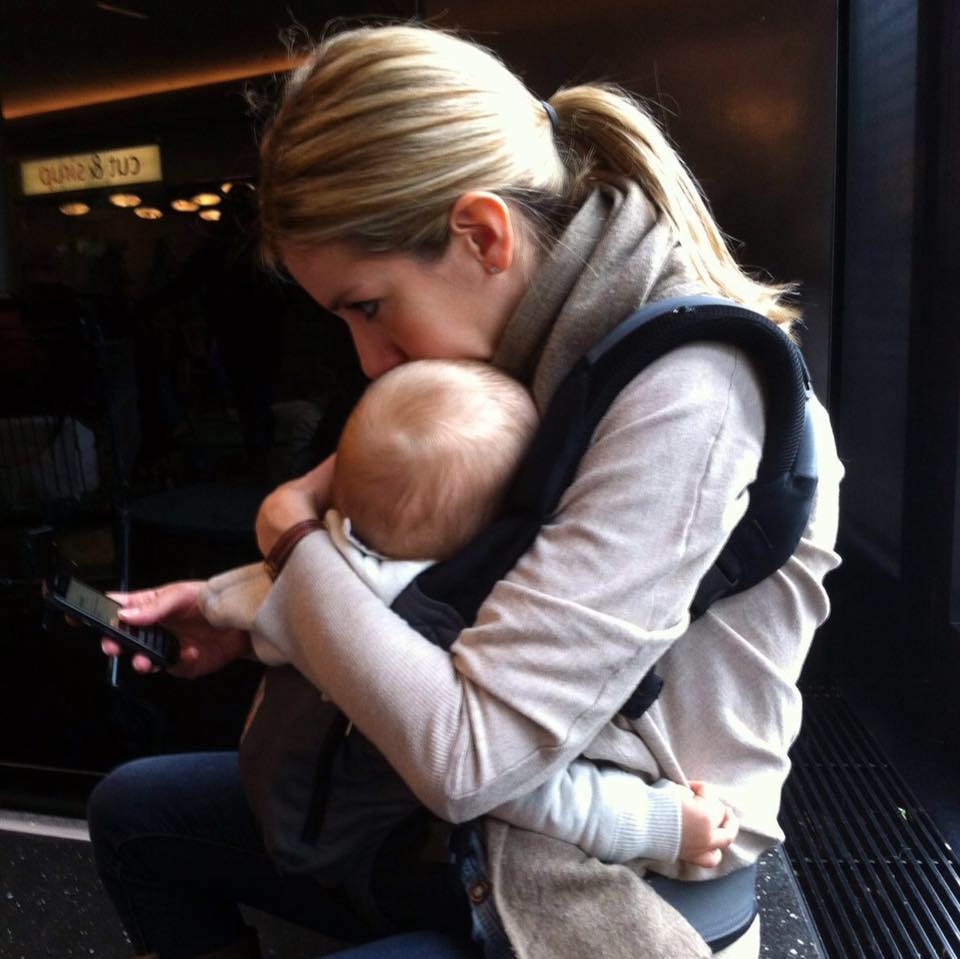
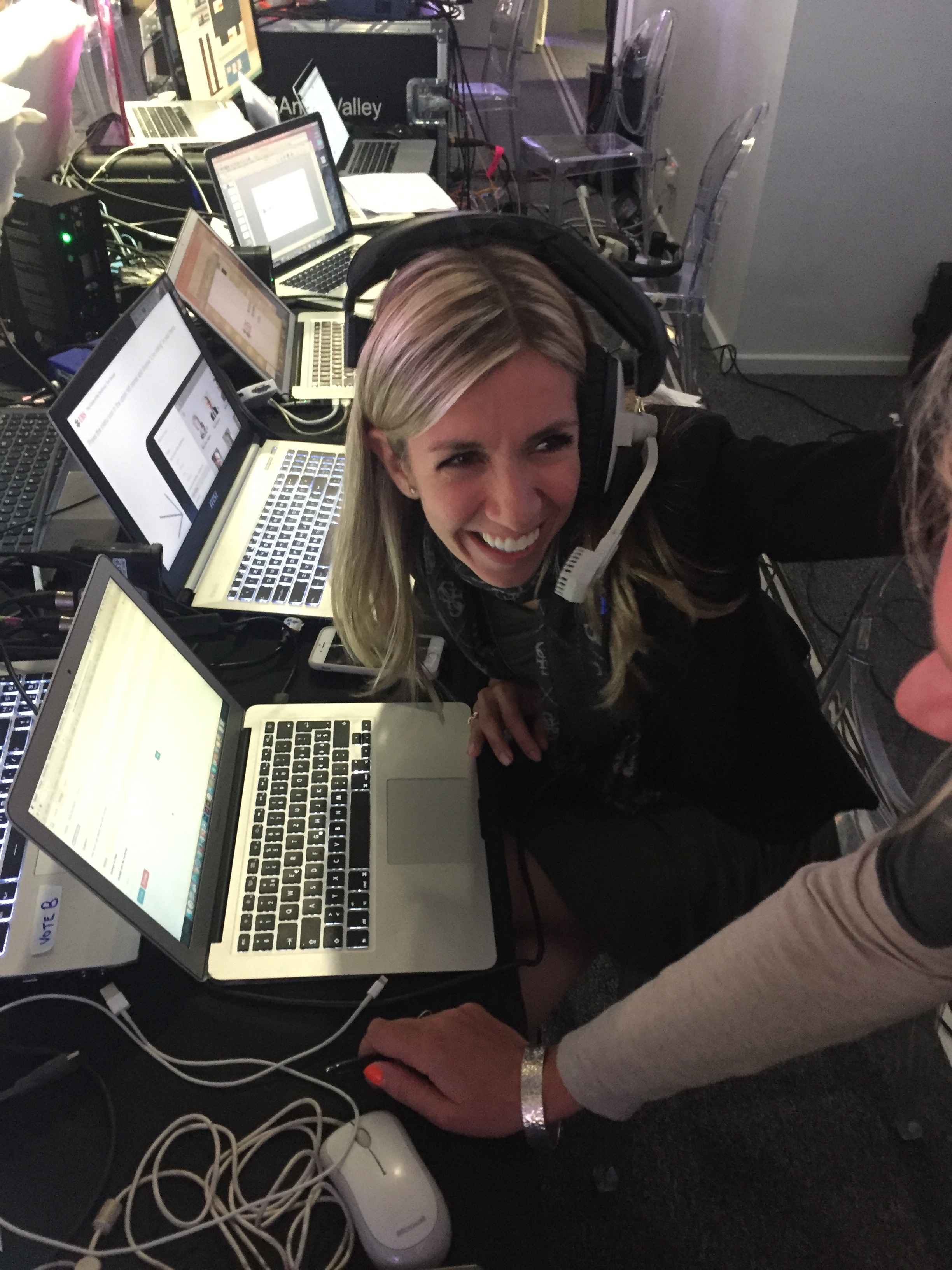
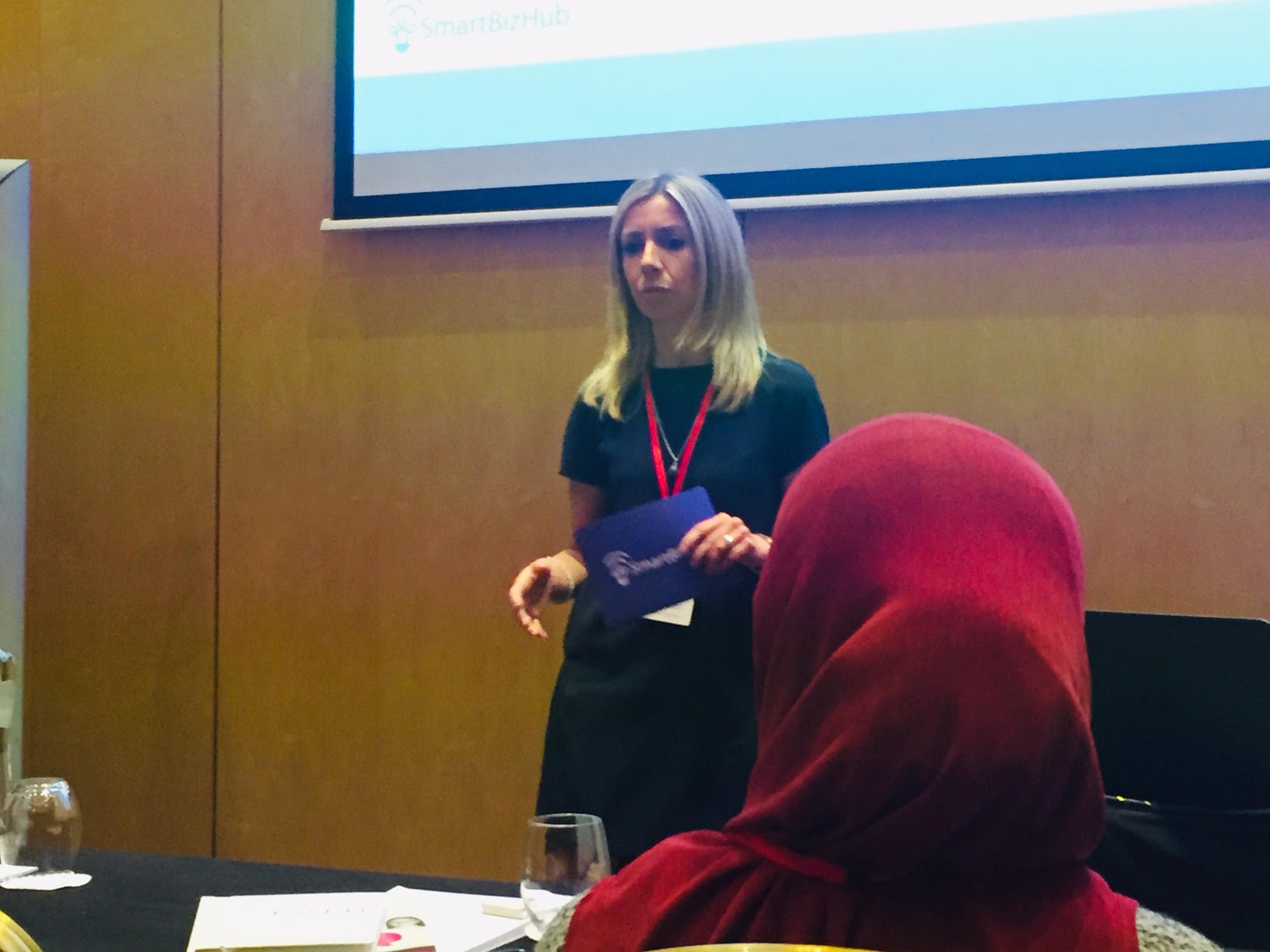
— Images, left to right: Manuela Andaloro moderating a FinTech international event in January 2019 in Zurich (credits: British Embassy Bern); speaking about adapting our working cultures to reflect a more modern world and diverse society, June 2019, Amsterdam. (Credits: EWPN, Money 2020); on stage speaking about new role models and leadership, October 2018, London (Credits: PayExpo); Balancing private life and work on a weekend. —
manuela andaloro intervista

The trump card that can reconcile career and family, says Manuela, is a new type of EQ-driven leadership. “The best leaders of today invest their time and energy in understanding the people they work with and their teams. It’s the EIQ, or emotional intelligence quotient, which experts say has become today more important than IQ and is a better index of success for people, companies and society. This is why we must work to change the old mindset: a new approach will not only favour women but will also foster a type of leadership based on empathic soft skills. In the digital age and its new challenges, women should not be fighting to integrate themselves into a system that has proved to be disastrous as it supports only one model, the alpha personality, mostly very dominant figures. I met women that had old-fashioned leadership styles, not very cooperative and participatory, and men who lead in an inclusive way and pay attention to the social fabric outside and inside the company. Adopting a leadership based on arrogance, blind self-confidence and lack of empathy does not work today, in the face of the probable failure of liberal democracies, the negative influence of social platforms, the climate crisis, artificial intelligence and the associated risks. Both women and men should all work together to transform the mindset of companies (and politics), making room for the new facts on the ground”.

For women, it means they have to learn to believe more in themselves, to not settle for less and to act, without always waiting for the right moment in decisions concerning private and working life – to have a child or to accept a new role of great responsibility that involves changes. “Sacrificing one’s ambitions even before trying is harmful to oneself, to other women, to new generations and to the men that are witnessing this behaviour”.

On 14 June, over half a million women and men across Switzerland joined the demonstrations following the strike, plus all those who participated in a “digital” way. What do you wish for, Manuela? “I wish for strong governmental reforms and independent inspections of companies to assess corporate culture, and diversity within them. And I also expect each of us to raise awareness of issues of vital importance, in each of our daily roles, as mothers, fathers, teachers, workers, leaders. Starting from making our children aware of the importance of equality, inclusion and an open mind-set to face today’s new challenges”.
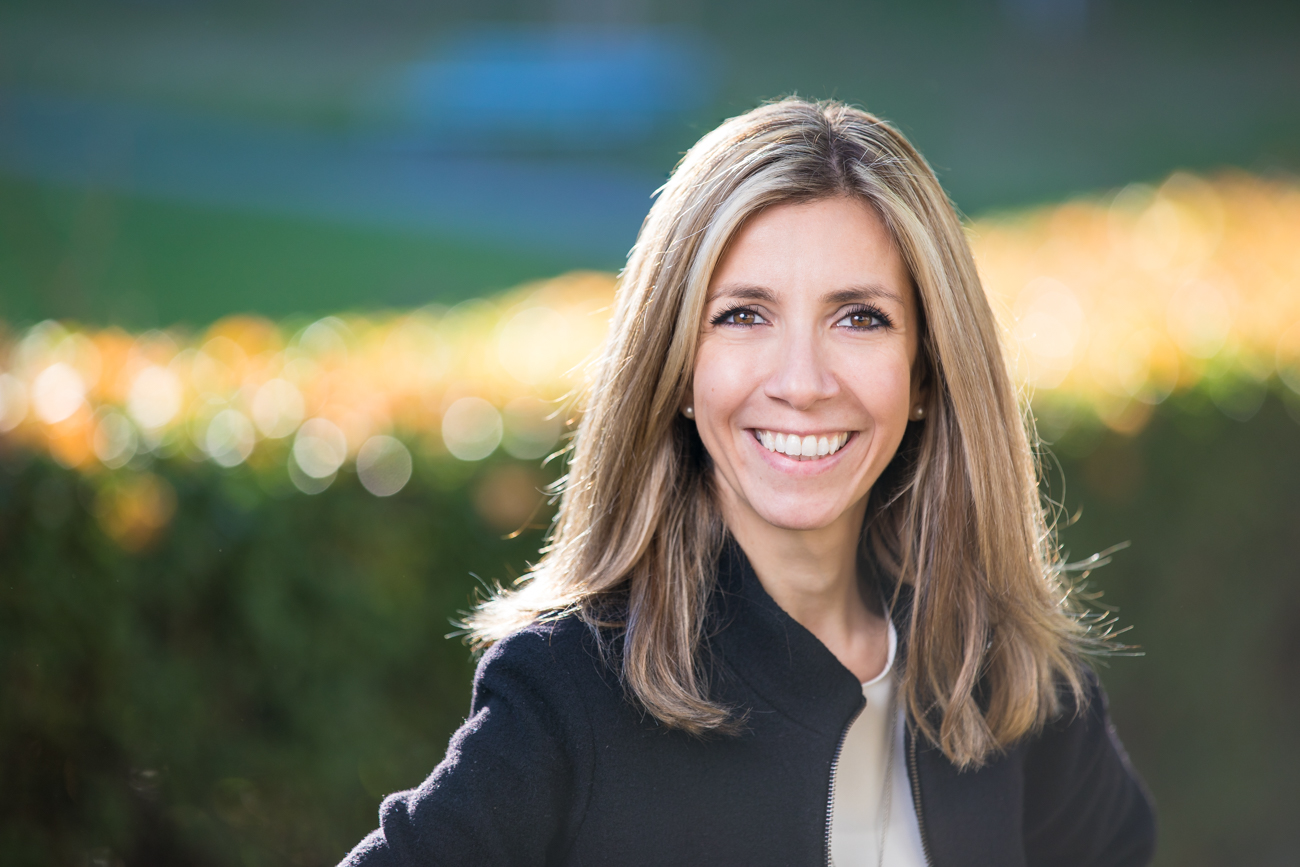
Valeria Camia with Manuela Andaloro

046-manuela-web-1300px-72dpi-0450.jpg

Manuela Andaloro is a senior professional with over 19 years of executive experience in global roles in financial services, business strategy and digital transformation, having lived in Milan, London and Zurich and worked for firms such as Nielsen, Financial News and UBS. Since 2017, she is the Founder of Swiss-based SmartBizHub, a management consultancy specialising in marketing, positioning, communications, sustainability, future tech and future work. Manuela is a professional speaker, a published author, and an editorial consultant for various leading publications on the topics of finance, social shifts, impact, culture and leadership. She serves as advisory board member of various Swiss and international organizations, and as a board member of the Weizmann Institute of Science in Europe. Manuela is a D&I champion and advocate for EQ- driven leadership, speaks English, Italian, German and Spanish and lives in Zurich with her husband and two children. 

As published in Corriere dell’ Italianita’ cover story, 30 July 2019 view original article in Italian here.

In Work-Life Balance, Zurich, Switzerland, Social shifts, Slider, Italy, Career, Business, Entrepreneurship Tags genderequality, change, social shifts, social change, diversity, EQ-driven leadership
Comment
FullSizeRender.jpg

Family Treasures.

April 20, 2017

I am one of those lucky people who have had the blessing of enjoying their grandparents well into their thirties, and hopefully until later on still. 

Having grandparents around has formed many of my opinions and stances in life, has given me a different take on history, sacrifices, resilience and family relationships. Their wisdom, beliefs, sometimes a bit outdated but so real, their hard work, their memories.

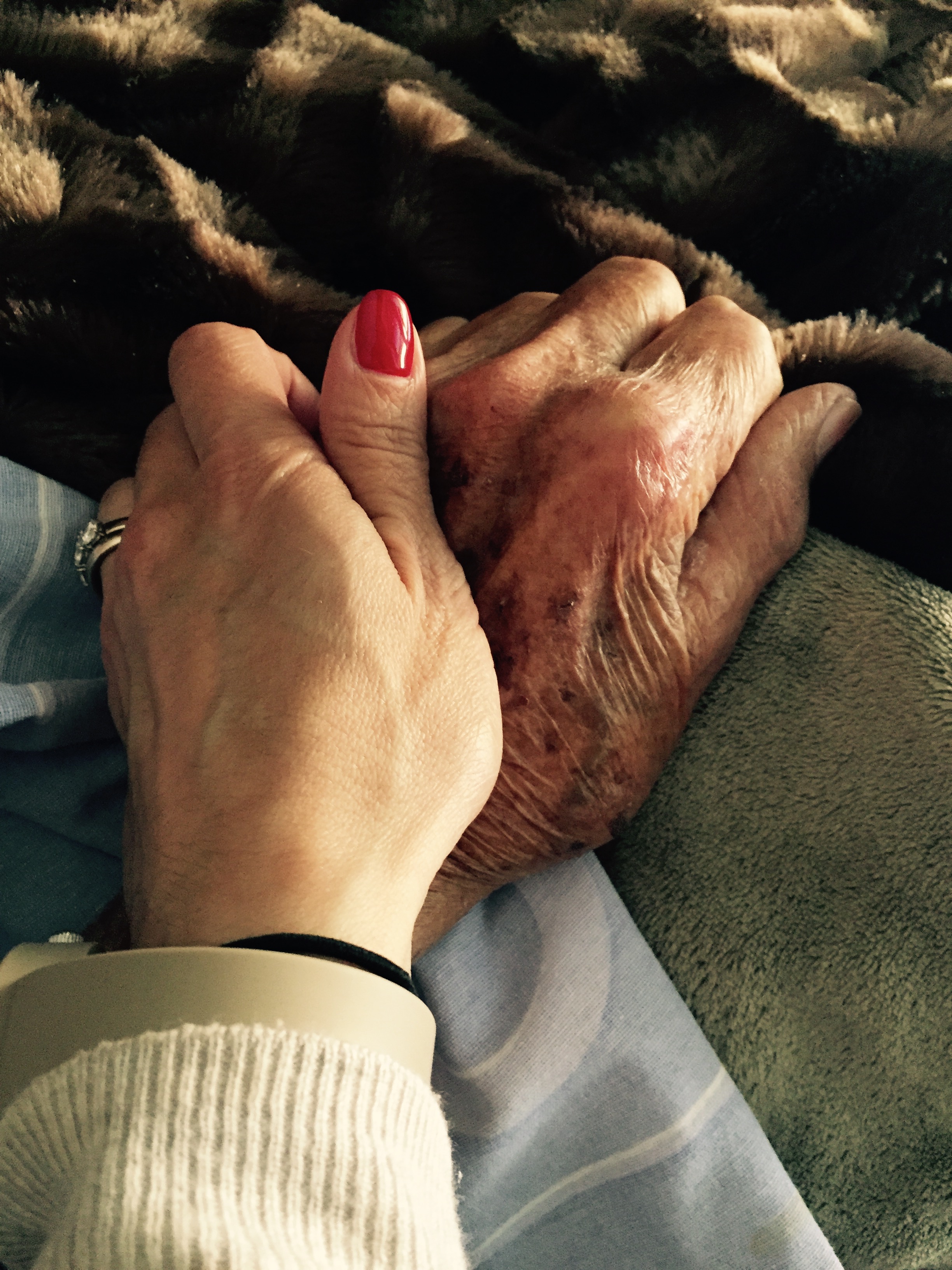
Their hands. Hands that used to make their own food, wine, olive oil, tomato sauce, made their own clothes, built and repaired everything, from watches to cars to their own houses. Hands that to this day help my own children picking cherry tomatoes from their plants. Stories of home births, friendships, respect, family bonds, lands, money, passions, shootings, war cutting through their own memories.

The stories of my great grandma, grandmother of my mother, who woke up every morning at 5am and walked up and down hills, whose long grey hair were tied up in a perfect bun every morning, whose piercing blue eyes had seen and lived through so much. Those same blue eyes that a hundred and thirteen years later came back in my second son. Her husband had fought in the first and second world war, twice came back, last time deaf, his hearing lost to the deafening noise of flying airplanes. I had the luxury to hold her hands until I was twenty one. I have very clear memories of hot summer visits to her house, I used to open the door, call her name while running up the stairs, then sit with her, or help her make bread, her bed, water her plants. She always had money for her grandchildren, so we could buy ice cream, more like fifty ice creams truth be told. Jumping around her when she went to pick up her own salad in her field and let me go with her, the simple acts can be the greatest source of happiness for children. Her rabbits, feeding them with her gave me one of the happiest memories I still nurse. She was so calm and still, I loved being around her. Her name was Venera, that too I loved.

The downside of having great grandparents is of course seeing them going. The last summer she was with us I sat there with her holding her tired hands, she was 98, still independent and doing well, she was afraid she told me, she knew she had to go. 

I have never been able to see them and enjoy them as much as I would have wanted due to distances, I remember crying loud as a child at the end of every summer when the time came to say goodbye. We did everything possible to see them often and they came to visit often, but to me, it never felt enough. 

Clear memories of my grandfather on my father`s side come back too. He had so many stories of his youth, so much passion for his family and was so keen for us all cousins, children of his six children, to play together and stay together, keep in touch through life, he built something close to a family residence in order for us to be able to see each other as often as possible, mostly in the summer, gave houses to all his six children, land to all and gifted his family with land too out of fraternity and generosity. He raised his children with his wife with the strongest love and fraternity bonds that to this day I have ever witnessed in siblings. I remember my grandma's happiness and how she laughed when she put my baby brother in my old father's walker, it was an ancient model with no seat and my brother's chubby wobbly legs scrambled. He was not happy, she picked him up, laughed more, conforted him. I watched her being happy. I used to walk with her in her backyard, we picked berries, she showed me plants. I remember her smile and her insuline syringes. Sadly I was six when she went, too soon. The legacy behind however lives on. The four brothers and one sister of my father would do anything for each other. Their parents gave always the highest importance to family bonds. Grandpa was so in love with his wife, until well after she was gone, over ten years later, he spoke about how beautiful she was and how much he loved her. It was an early lesson of what I wished for in my own relationship. He had deep respect for his friends and his closest friend, the Count of his town, until the last year he lived he insisted on visiting the only daughter of his long gone friend, who by then was in her late 60ies and had no children, living mostly in London and returning to the family lands only once a year. He was there to visit her as he had promised his friend, her father, he would be there for her. 

At five years old I remember insisting on cutting a biscuit with a knife, for some reason I got away with trying and ended up slicing my finger. I remember to this day the warm touch of my grandma who held my bandaged finger till I fell asleep. Mums have no time for that, as a mum now, I know that well. But grandparents do. They infuse that patience and calm and love in children that no one else can match. The patience and care of my grandpa taking me to his lands to pick nuts and figs as a child, my little tantrums and their smiles. The little hand-made baskets I was given, the simple soothing things they would do for their grandchildren.

I feel sad in a way that due to the fact that many of us are having children later in life a whole generation will somehow miss out on being a young grandparent and the next generation will miss out on the invaluable treasure grandparents can be. Yes, we live longer, but no one is getting younger.

All of the above was possible thanks to the fact that my grandma married her ten years older husband at seventeen and had a baby, my mum, almost immediately, my own mother had me at twenty-five, and then off I went and only sat at thirty-two years old, seven months pregnant, in a birth class of first time mums where I was the youngest woman. 

The downside of my invaluable memories with my grandparents is seeing them aging and having had to say good bye once I had got to know them well. Seeing them dealing with the brutally miserable aging process. Losing their strength, losing some of their memories. A part of you goes, at the same time they live in you, but they are no longer there and every time the memory comes back, it stings.

FullSizeRender.jpg

Over the past few years I have done what I could to bridge distances. I have two grandparents left, and I treasure them. I have been flying my grandma over to visit us twice a year, visited whenever I could, face-timed, with my brother we massaged their tired shoulders, played cards, sat with them, asked them of their past. To bridge distances and my own guilt for not being closer this year I bought massage devices and sent massage therapists. Spent sleepless nights going through pictures of the past 90 years, together with my mother, to prepare the album of his entire life for my grandpa's 90th birthday. Fearing I would not make it as his health started to deteriorate 5 weeks before his big birthday. Some of his memories are gone. I was holding his hand on Easter Monday, relieved that despite the last few tough weeks he is doing better. His mind still works and memories are there but some are faltering. He recognises me, but asked me where do I live now. "Ah, I have a granddaughter who lived in England and now lives in Switzerland, works for a big company, my wife knows everything about her". Grandpa who is she I ask? Is it me you are talking about? "Ohhh yes of course it is you!". Somehow the memory doesn't overlap with the person at all times. Our minds are incredible places. Class 1927, he was the first boy in his town to complete higher education, helped me with mathematics homework during my long summer holidays, had a precise engineering job, could calculate faster than anyone I knew. Now memories are unclear. I pray he will recover most of his health but time is ticking and I cherish my own memories, grateful of the gems I have been given, wishing for my children and for the next generation to learn the same love and respect for our family treasures, for our past, for History.

M. 


In Healthy Living, Work-Life Balance, Parenthood Tags Family, happyliving, parents, Grandparents, balance, ownthewayoulive
Comment
High energy. Switching roles with the show director during an event in London last September.

High energy. Switching roles with the show director during an event in London last September.

What's your inner pace?

November 28, 2016

Last summer I was invited to a talent development offsite,  'women fit for success'. I very much enjoy and applaude these programmes and investments on the company's talents, but I do wonder whether tailoring programmes specifically for women doesn't make the problem of gender equality in the workplace even worse.

Nevertheless, I pack my overnight bag and off I go. The whole two days programme was very interesting, one thing in particular has hit a nerve, the pace calculator exercise. 

After a short networking lunch on day 2, that followed an intense morning and an even more packed day 1, we are asked to stand up from our chairs and start walking in circles around the room, following the pace that the workshop leader would indicate. 

Mentally I wonder 'Seriously, with all the emails piling up in my inbox, my endless to do list, why are we doing this random exercise now?' It took fifteen minutes before realisation hit home and I saw how important is my inner pace, at any given time of the day, and how I could make that work to my benefit. 

So we keep walking in circles, slowly, then fast, then very fast trying to avoid collision with the other twenty ladies, then almost running, then very slowly, then we are asked to choose our pace and keep walking. 

My pace of choice that afternoon after lunch, from 1 to 5, where 1 is slowly walking as if you are admiring art in a museum and 5 is rushing for the train in heels, was 2/3. I felt uncomfortable with 4 and 5, almost annoyed, and so I did with 1 and 2. 

How would my mind and body perform when forced out of their natural pace in a particular moment?

Sunday walks.  

Sunday walks.  

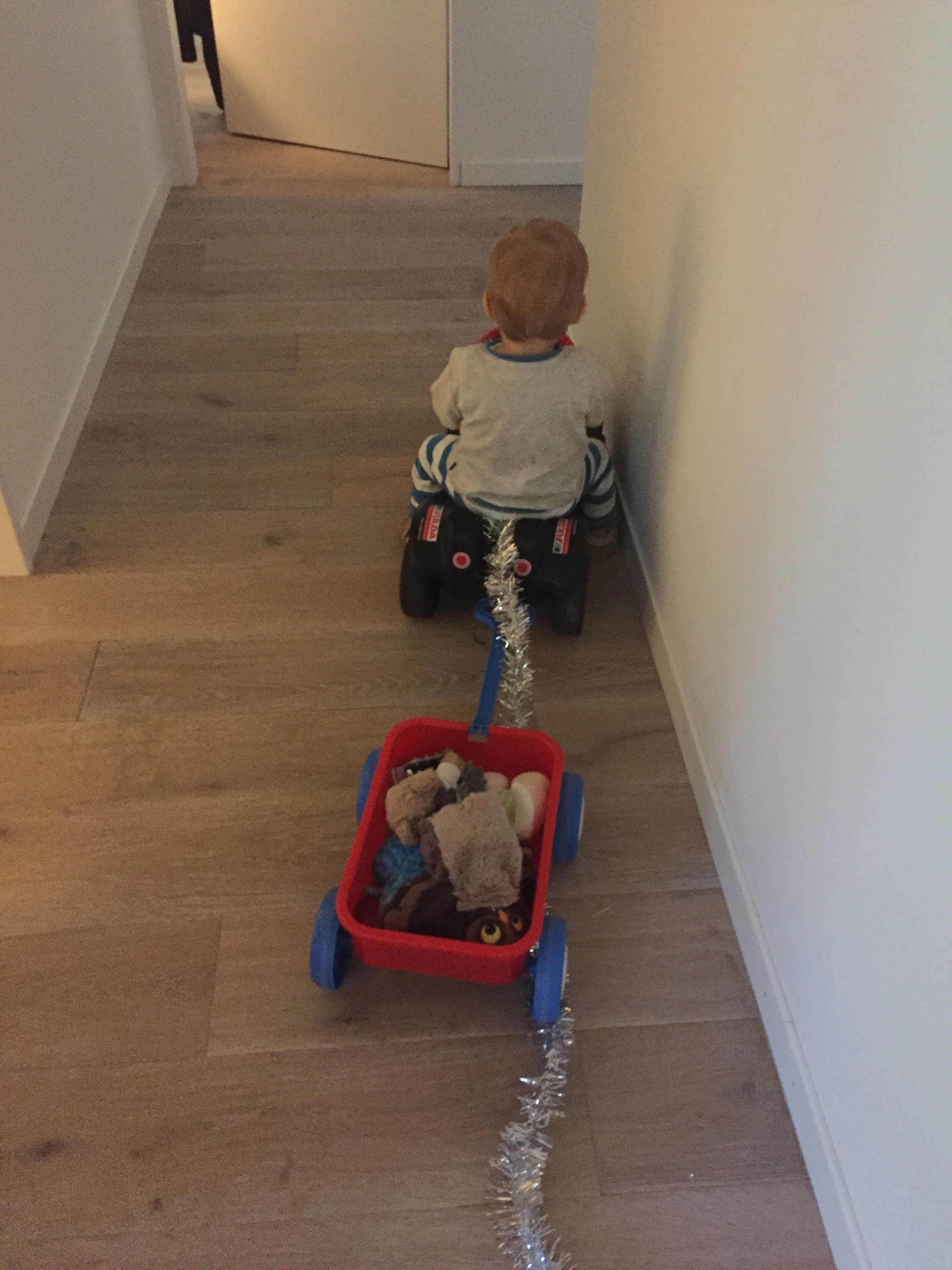
Following the whereabouts of the youngest driver in the house. 

Following the whereabouts of the youngest driver in the house. 

Being a 'morning person' I know that would I have done the same exercise at 9am through to 12pm, I would have gone for 4 or even 5, at 5pm to 8pm probably as well, but after lunch? My mind needs focus and slow pace, as much as it needs adrenaline in the morning and early evening. Your 'inner pace' can also change depending on the time of the year, after a regenerating holiday you would probably choose a pace 5 throughout the day as much as after a long year and a particularly tiring patch (erm) you would probably want to hide under the duvet, no I meant choose a pace 1/2 more often.

Our take away, you have guessed it, was to learn to tailor our days, workload, tasks, based on our personal natural pace. Not that often we are given the choice (hello 1pm meetings) but knowledge and self awareness always make you score higher.

M.


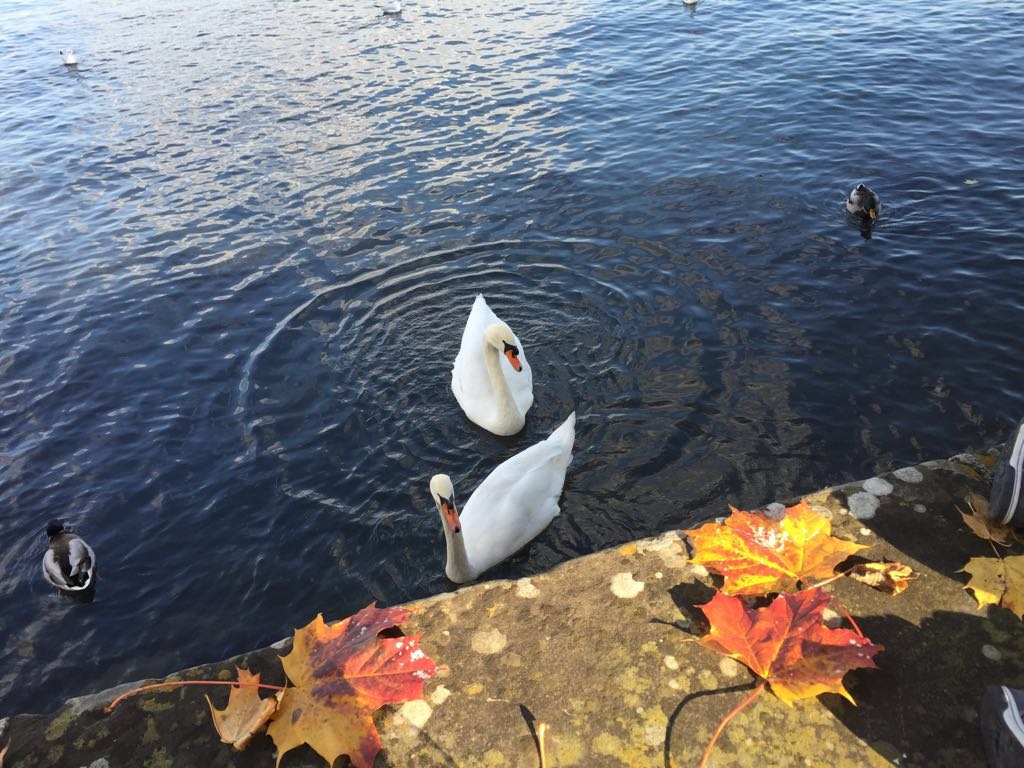
Walking down the Zurich lake on a Sunday in October during a 'pace 1' afternoon, reminded me of the funny picture below someone shared with me. 

Walking down the Zurich lake on a Sunday in October during a 'pace 1' afternoon, reminded me of the funny picture below someone shared with me. 

IMG_5382.JPG
In Slider, Career, Work-Life Balance Tags womenmatter, ownthewayoulive, workingparents, diversity, leadership, productive, worklifebalance, productivity, working mothers, futureworkforce, futureworkplace, Goal setting, genderequality, Career, Mindfulness, happyliving, work life balance
6 Comments

Needed: Culture change!

March 11, 2015

Increasingly in the past few months, there has been a lot of rumour about the roles of working mothers (as in paid work) and fathers:  politicians, employers,  society, doctors, families themselves, all have an opinion on the topic of women choosing (or wishing to have the freedom to choose) to work while raising a family, and possibly even progressing in their career while doing it.

Now, as a working mother I think I can speak for many of us when I say that managing family and work is a daily difficult balancing act. It is just challenging to squeeze your working day down to the nursery/nanny/schoolhours, to maximize every hour, to have endless to do lists for work, home and everything in between and last but not least, to make everyone happy, including yourself. Of course there are practical things you can do to help you through the week, housekeepers and the likes do help but at the end of the day no one can replace any of your roles as parent, spouse and professional.

On the work front, often the above challenges are matched with employers who have very little understanding of the well being as a whole of the individual and who have yet to understand that for all employees of all ranks there is no one-fits-all format for their personal success, development and for their productivity. A happy individual, who also thanks to his/her employer is able to achieve a good work-life balance, will be way more committed and successful in his/her job than an employee who suffers from lack of empathy and little understanding or flexibility. A very good example is given by the latest flexible policies wanted by Richard Branson for his companies. And latest in time the announcement of Vodafone of last week.

On the society front, there are also things that could help. Longer nursery and school opening hours, being able to share parental leave with your partner, enabling fathers to work flexibly without stigma, subsidizing childcare costs, allowing for longer/better paid maternity leaves and removing the equation motherhood plus  flexible working  equals end of a woman`scareer. This has been the case for too long now and I believe that the time for women to speak up has come. 

By promoting and implementing flexible working models , measuring performance not by the hours but by results and allowing families to make free choices when it comes to childcare and career, we can enable and retain in their jobs  many talented women and men, who will be, in different ways, able to fulfil their potential and to have a more balanced life, this in turn will increase productivity and decrease sick leave absences at work and have a positive economical impact on our society.

What`s not to like about it?          

M.


In Career, Parenthood, Work-Life Balance
Comment